
Our take
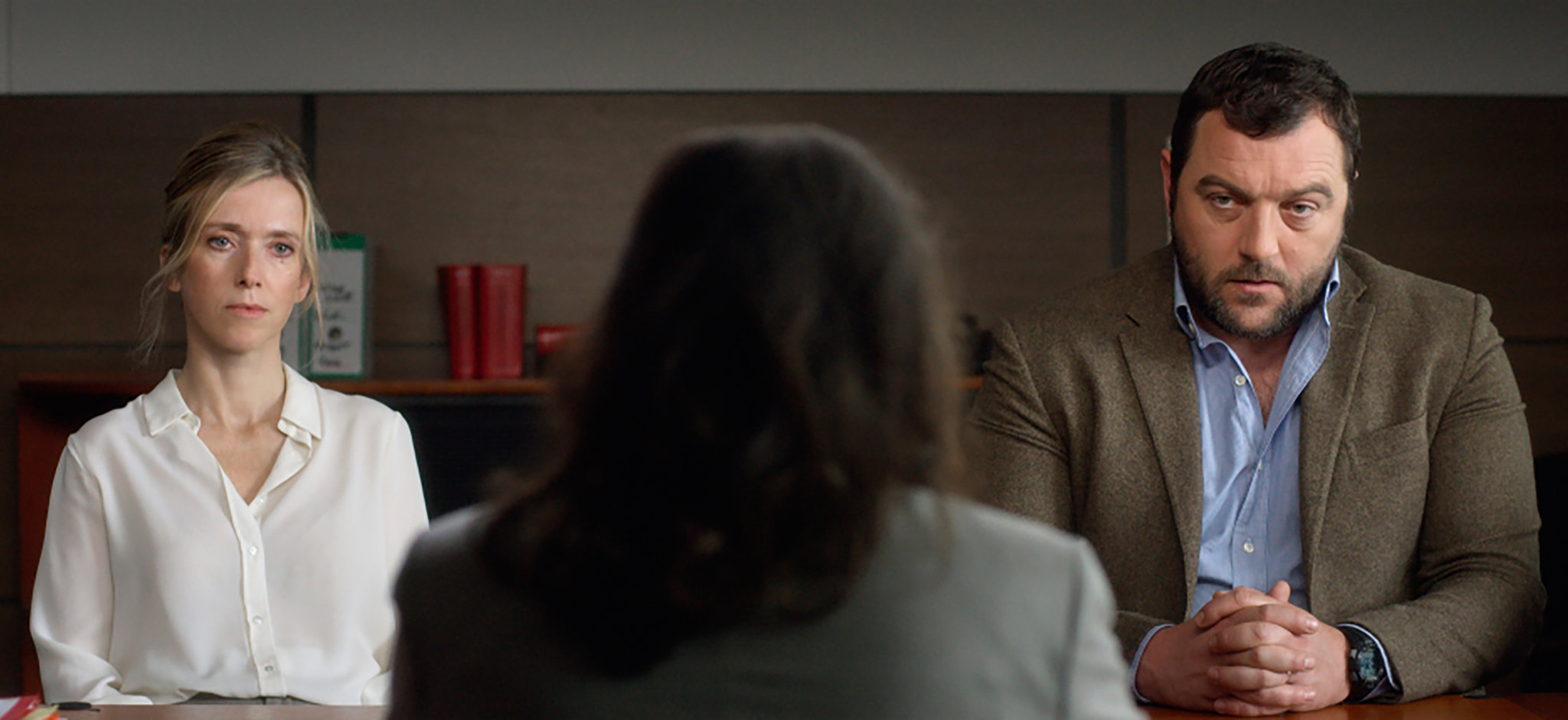
During Custody’s opening scene — a judge-mediated custody hearing between ex-spouses Miriam (Léa Drucker) and Antoine (Denis Ménochet) — the latter’s lawyer pleads with the judge to side with her client, arguing that, despite his reported history of violence and the reluctance of the couple’s 11-year-old son to live with him, “Nothing here is black and white.” Custody plays something of a poker face in its first few minutes, leaving us as reliant as the judge is on arguments like these, but outside of the mediation room, the film’s tight 93-minute runtime builds to a finish that will conclusively — and terrifyingly — prove that claim false.
The skill of Custody, however, is in the fact that we don’t need this definitive proof to form our judgment, because we can feel the silent threat of it in every preceding frame. Each of its naturalistic scenes, whether ostensibly quotidian or celebratory, is suffused with simmering dread and ticking tension; even when he’s absent, Antoine looms over the family’s life like a dark cloud. With such restrained mastery over a thriller-like tone, Custody reveals the family’s all-too-common reality as the horror it really is.
The story
Miriam and Antoine have recently separated. While she’s willing to permit their 17-year-old daughter Josephine to decide living arrangements for herself, Miriam is desperate to keep her youngest, 11-year-old Julien, away from his father. But the magistrate rules in favour of joint custody, and suddenly the boy is thrown directly into the middle of an escalating parental conflict, where it seems inevitable that sides must be chosen.
Elsewhere

"Legrand... seems precociously adept at turning the screws of suspense..."
— Anthony Lane

"An accomplished debut, with chilling performances from the two leads."
— David Jenkins
A young boy at the heart of a custody battle tries desperately to navigate the impossible position he’s been put in.
It goes without saying that Ménochet has a big part to play in crafting the film’s stewing sense of menace, but his work is magnified by everyone else’s reaction to him — in particular, by Thomas Gioria’s performance as Miriam and Antoine’s young son Julien. Director Xavier Legrand often sets the camera at Gioria's eye-level to embed us in the impossible position the courts have forced Julien into. The agonizing pressure placed on his young shoulders — to protect part of his family and assuage the rage of the rest — is horribly palpable on Gioria’s face and in the way he uses silence as a defense mechanism. To be sure, the strength and subtlety of his performance make for an intensely harrowing watch, but it’s essential to conveying the emotional reality of the subject matter.
A deserved double winner at the Venice Film Festival for its intense evocation of an all-too-real nightmare, this one comes with a big trigger warning.
Who picked it

Farah Cheded is a UK-based curator at A Good Movie to Watch and a Rotten Tomatoes-approved freelance critic whose work has been published at outlets including The Playlist, Paste Magazine, and Film School Rejects. She lives in fear of the day she runs out of 'Columbo' episodes to watch.