
 2022 Movie
Dir. Jerzy Skolimowski · Italy, Poland · English, French
A thoughtful glimpse through the eyes of a beast of burden that doubles as a disconcerting portrait of humans
It’s a bold move, centering a drama around a creature as docile as a donkey, but EO pulls it off without ever leaning on the crutch of CGI. Instead, the film makes ingenious use of a hundred-year-old film technique: the Kuleshov effect. By splicing the image of the titular donkey’s placid, expressionless face against visual stimulus, the illusion of a genuine reaction is produced.
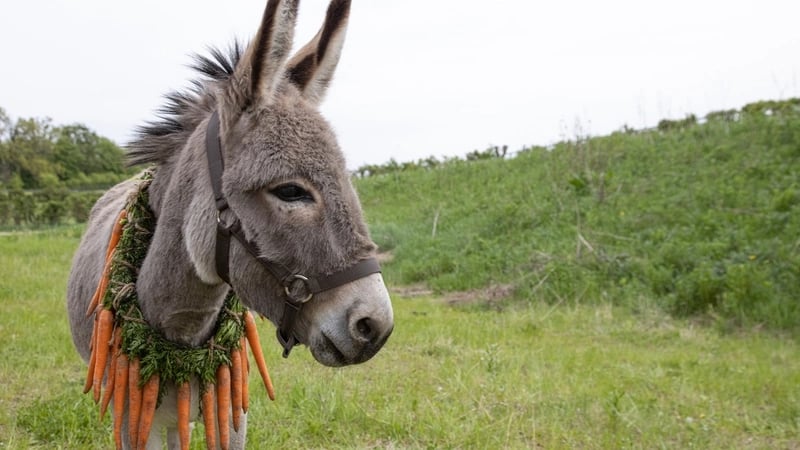
But don’t be mistaken: this is no twee Disney-esque tale of anthropomorphism. Inspired by the classic Au Hasard Balthasar, EO tracks the haphazard journey of a former circus donkey across Europe — one that is often depicted in surreal psychedelic reds instead of idyllic picture-book tones, and punctured by more horrors than joys (though we do, thankfully, get to see him munch away on some well-deserved carrot treats). EO’s docility frames him as a kind of holy innocent, making the cruelty meted out to him feel all the more like a grave violation of something sacrosanct. Seeing the world through his oft-neglected perspective also makes this a movie about humans by proxy — a fresh, empathetic approach that, even in its obvious dramatic liberties, makes us meditate on both the depth of experience that may be unfolding in our animal neighbors and our role in shaping it.
The world is a mysterious place when seen through the eyes of an animal. EO, a grey donkey with melancholic eyes, meets good and bad people on his life’s path, experiences joy and pain, endures the wheel of fortune randomly turn his luck into disaster and his despair into unexpected bliss. But not even for a moment does he lose his innocence.

"EO’s personality shines thanks to Skolimowski’s daringly imaginative depictions, both visual and emotional, of the donkey’s point of view."
— Richard Brody

"A winding existential journey packed with emotional and political punch."
— Mark Asch
After being freed from a circus, a donkey experiences tenderness and cruelty as he’s shunted across Poland and into Italy.
Unsurprisingly, EO isn’t a big talker (though he does let out a few hearty brays here and there), so it’s up to cinematographer Michal Dymek and composer Paweł Mykietyn (along with editor Agnieszka Glińska’s aforementioned cuts) to let us into his emotional state. The spectrum of feeling conveyed in their work gives affirming depth to the movie’s central point: that we could do with being more curious about the lives of those we share the planet with.
If this is an accurate depiction of donkey life, no wonder Eeyore was always so depressed.

Farah Cheded is a UK-based curator at A Good Movie to Watch and a Rotten Tomatoes-approved freelance critic whose work has been published at outlets including The Playlist, Paste Magazine, and Film School Rejects. She lives in fear of the day she runs out of 'Columbo' episodes to watch.
Comments