
 2002 Movie
Dir. Todd Haynes · France, United States of America · English
Todd Haynes’ sumptuous, unabashed melodrama finds a paradoxically perfect marriage between form and content
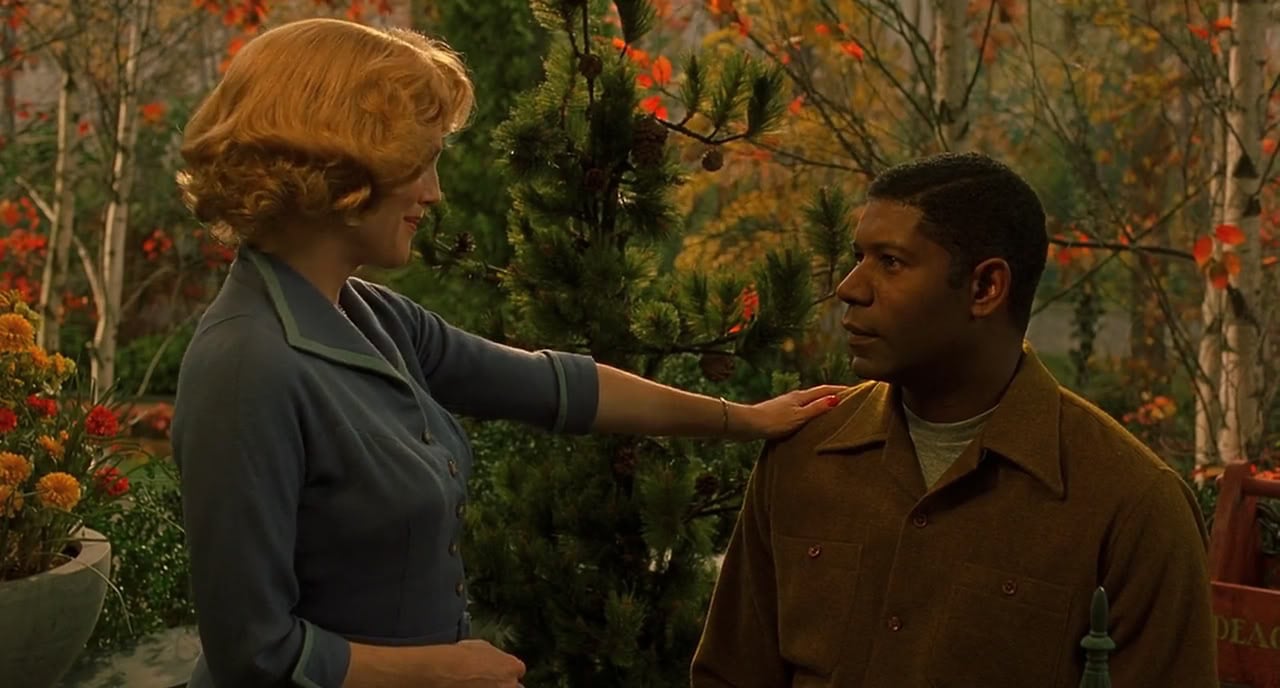
Anyone who’s seen All That Heaven Allows will naturally be skeptical that a movie claiming to be an homage to Douglas Sirk’s sumptuous masterpiece will live up to the heights of its inspiration. It’s a ballsy move, molding your film so closely to a peerless classic, but Todd Haynes transcends thin pastiche to be a genuinely great film of its own. Where Sirk’s movie charts the social scandal caused by an upper-class widow (Jane Wyman) falling in love with her gardener (Rock Hudson), Haynes sharpens the conflict by recasting the couple as an interracial one (played by Julianne Moore and Dennis Haysbert). What’s more, Haynes brings her husband back from the dead and into the closet to give Far From Heaven another angle through which to tackle the repression and stigma and explore the characters’ rocky pursuit of happiness. If that sounds like the stuff of melodrama, it is — Far From Heaven is proudly of that genre, cracking through the veneer of suburban perfection to find roiling tension and repressed desire underneath.
In 1950s Connecticut, a housewife's life is upended by a marital crisis and mounting racial tensions in society.

"With tact and care, the movie digs into all the subjects that lay concealed below the surface when Max Ophuls and Douglas Sirk were filming their own melodramas in the nineteen-fifties."
— Anthony Lane

"Achieves the same sentimentality as the Sirk films, and in much the same way."
— Peter Rainer
When her marriage implodes, a suburban housewife finds comfort in her gardener, but the interracial nature of their relationship causes a scandal in 1950s Connecticut.
Sirk’s classic is arguably the most beautiful film ever made, a tall order for the artisans who worked on Haynes’ homage to emulate, but happily, the result here is similarly stunning and meaningful. Edward Lachman’s gorgeous expressionist cinematography — vibrant autumnal color, theatrical Dutch angles — Sandy Powell’s similarly dazzling costumes, Mark Friedberg’s lush production design, and Elmer Bernstein’s grand score all stun, but what’s more, they heighten the jarring juxtaposition of outward perfection and interior turmoil, artifice and truth, that is central to the film. There’s much substance in all this exquisite style.
Edward Lachman, take a bow.

Oscars
4 noms

Venice
4 wins · 1 nom

Golden Globes
4 noms

SAG Awards
2 noms

Spirit Awards
5 wins

WGA
1 nom

Nat. Board of Review
2 wins

NYFCC
2 noms

LAFCA
4 wins · 2 noms

European Film Awards
1 nom

Farah Cheded is a UK-based curator at A Good Movie to Watch and a Rotten Tomatoes-approved freelance critic whose work has been published at outlets including The Playlist, Paste Magazine, and Film School Rejects. She lives in fear of the day she runs out of 'Columbo' episodes to watch.
Comments