
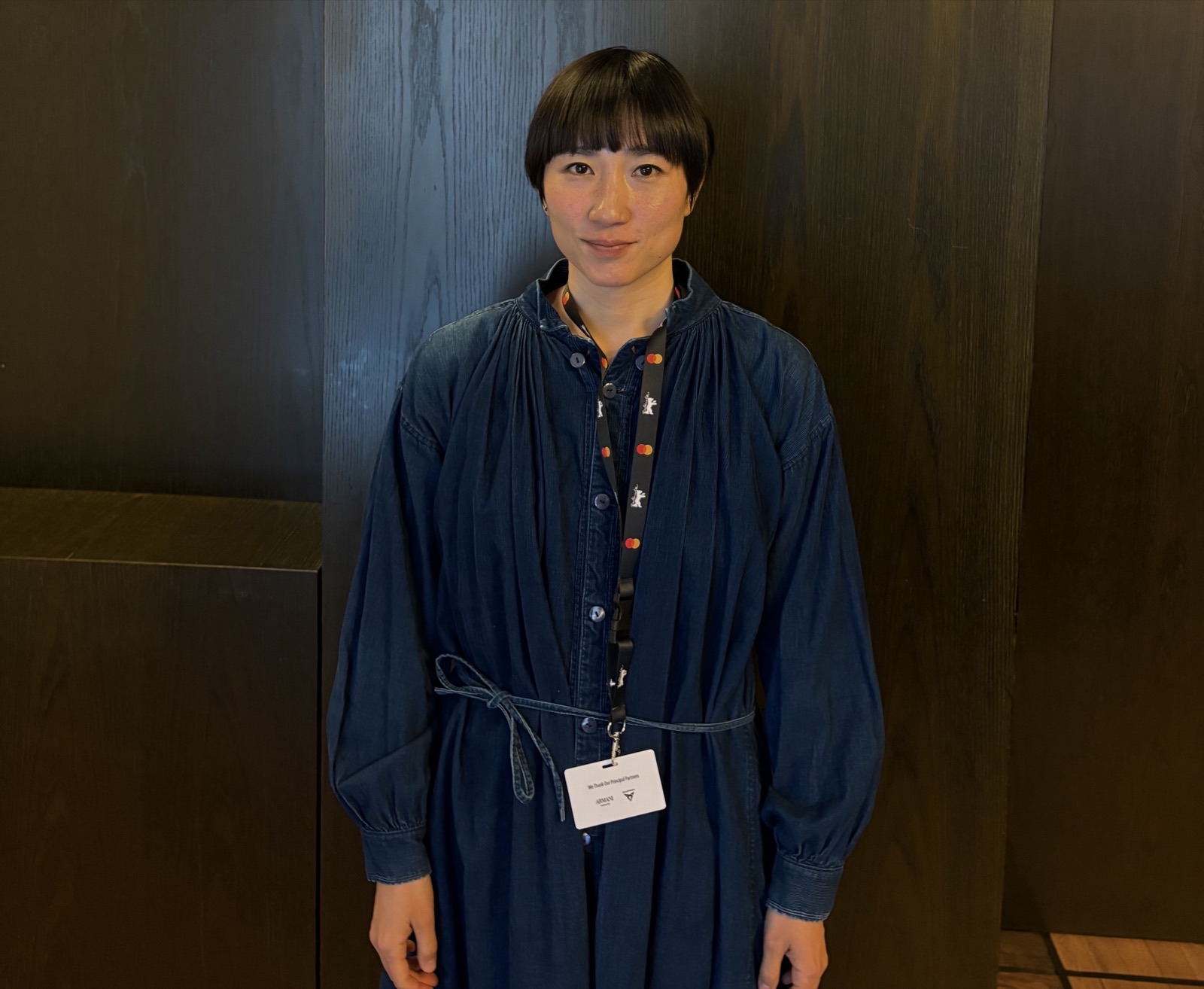
Masayume is Nao Yoshigai’s intimate hybrid of documentary and performance, made in the aftermath of losing her mental and physical balance and, later, her mother. A dancer and filmmaker, Yoshigai retreated to a Zen temple, and the film weaves the real training she did there together with staged dreamlike sequences: a woman who falls in a field and turns into milk, a mountain built of rice with milk pouring from it.
It is also a film about photographs taken during her most unstable period, and about a monk who cooks every meal and happens to be a licensed counselor. We spoke, with an interpreter, about how much of the film is real, why a documentary about grief is built mostly from audio, and what it means to discover that everything, even a bottle of water, is Buddha.
The film is labeled a documentary. How much of it actually is, and how much is staged?
When I make a film, I do not write a script with dialogue. Instead I make something like a kamishibai, the traditional Japanese paper storytelling format, and use it as a kind of mood board to roughly shape the overall structure. The fictional, performance scenes were imagined beforehand. For example, the scene where I walk through the grassland, fall down and turn into milk, or the scene where I build a mountain out of rice with milk flowing from it. But the training scenes in the Zen temple were entirely documentary. If I had to estimate the balance, I would say roughly forty percent was staged and sixty percent was real.
How did you make the people in the temple so comfortable with the camera? I imagine it is not a place used to being filmed.
I met most of the people in the temple for the first time then. Because it is a space for spiritual practice, I first asked each person individually whether it was alright to film them. I explained why I wanted to make a film there. I told them that when I had lost my mental and physical balance, I came to this temple to train, and that it had a very positive impact on me. After that, the cinematographer, Kaori Oda, and I joined the training ourselves for a few days, together with everyone. Then I stayed and filmed the people practicing for about a week.
One of my favorite parts is in the kitchen. Can you talk about the monk and his personality?
The monk was in charge of the temple cooking when he himself was training in Zen. In Zen, the cooking itself is part of the training. We call that role the Tenzo. So even during our training period he personally cooked for everyone, every single day. At first I thought he simply did not let other people cook because he did not like their food, but that is his practice. And I think he genuinely loves it, because every meal was truly delicious. He is a very honest and straightforward person, very insightful, and also very funny.
The film opens with a flood of photographs. Where do they come from?
Those photographs were taken during the time when I had lost my mental and physical balance, when I was in a very unstable state. I was carrying a camera with me all day long. It was not only a film camera. I was also recording video and voice memos on my iPhone, and in my sketchbook I would quickly draw or write down whatever came to mind. The photographs in the film all come from that period. I arranged them chronologically, from the very beginning to the end, and that sequence became the opening of the film. I do not know how many there are.
Was it cathartic to go back through all of that material, or was it frightening?
It was frightening to look back at those materials. I was afraid of what I might see. But even though I was scared, I decided to look. When I did, it was very clear why I had been taking these pictures. I really was not well, and I became aware of that. But at the same time, when I was taking them, I truly felt that everything in the world was beautiful. I photographed the things I found beautiful. So even now, when I look at them and wonder why I took this, I still feel that they were beautiful.
Zen teaches you not to lean on stories or narrative. Yet you made a narrative film. Was making it a kind of therapy?
Through making this film, I became healthy again. If I had not made it, I probably would never have looked back at the photographs from that time when I was not well. I also would not have gone back and unearthed old video, like the footage my father shot of my first birthday, when I was one year old. For me, that act of looking back, of repeatedly returning to the same materials and editing them over and over, became a process through which I could gradually and very naturally accept things that were extremely difficult to face: the fact that I had lost my health, and the fact that my mother had died. Slowly I came to accept those events as a reality that truly happened, just as they are.
That is very vulnerable, to then put your grief out for other people to see. Are you nervous about so many people watching?
Yes, I do feel some resistance. Sometimes I wonder, is this really okay? I never imagined it would be screened at the Berlinale. But from the moment I started, I was making it as a film, so of course I wanted people to see it. If you ask whether I feel some hesitation, yes, a little. But at the same time I am happy for everyone to see it.
The monk says that human life has no value. Why does that help?
When I first went to the Zen temple, the monk did say that human life has no value. But at the same time he said something else. He said that everything has Buddha nature, that everything is Buddha. He did not mean only human beings. He meant a computer, this object here, a bottle of water, the air, buildings, everything. All things, he said, are Buddha. It is difficult, but I realized that even the idea that something has no value is determined by my own subjective perspective. So when he said that all things share the Buddha nature, something inside me felt lighter. I felt a sense of relief.
And the idea that our emotions are like dreams?
The monk told me that thinking something is sad, or thinking something is joyful, are both like dreams, and that we have to realize that both happiness and sadness are dreams. Connected to what he said about human life, I began to feel that my emotions are, in a sense, only dreams. They arise and they pass. What truly exists is what actually happened in the world. My mother died. That is a fact. It is difficult to explain, but it is as if only the fact itself remains.
To me it felt like a very universal story, a child who lost a mother and a grief no one around really understands. Would you recommend this Zen understanding to people who are not Buddhist?
It may sound obvious, but I came to really understand that everyone dies, that this is something completely natural. For me, Zen is about releasing, and releasing is relieving. Releasing means you do not stick to anything. You do not cling to your love, your anger, your greed. You just release everything, which means accepting everything as it is. I think that is common across spiritual practice, in Islam, in Christianity too, this idea of not holding on.
At the temple you found people who looked completely normal but were carrying a lot. Can you talk about that?
When you first meet the people there, they all seem very normal, like people living their lives without any particular problems. The monk studied psychology and was familiar with group therapy, and at the center they say that speaking is a form of release, that you should actively talk about your trauma, your worries, your sadness. So alongside the training there was a tea time when we began talking with each other. Once people started speaking, someone who appeared completely normal would suddenly share something, and some began to cry, and sometimes another person would start crying with them to comfort them. As the monk put it, when people truly encounter each other, a kind of emotional dynamism emerges between them. People, perhaps especially in Japan, are very good at maintaining a composed exterior. Unless you actually listen to them, you do not really know how much suffering they are carrying inside.
You have a dance background, and the film is very physical. Do you feel you dealt with the trauma in your body?
I continued practicing Zen at home, doing something like tai chi, eating simple meals of rice and miso soup in the morning, and chanting the Buddhist sutras in a very loud voice, which is really a physical thing. Gradually the trauma that had remained in my body began to fade. Sometimes it still hurts a little, but the feeling that it would stay with me forever has largely disappeared through making this film.
The scenes where people share and cry are audio only, not video. Why did you choose to break that documentary convention?
I am actually not very comfortable recording people on camera in a formal way. It makes everyone self-conscious and tense. I get nervous, and the person I am speaking with also becomes nervous. So instead I prefer something more casual, like having tea together and just talking naturally. Simply placing a recorder on the table and letting the conversation flow is much easier and more comfortable. I planned to record only their voices, not to film. In fact, no one happened to cry in front of the camera, but some people spoke about their suffering while the recorder was running, and at one point I began to cry myself. That moment is in the film. I also think it has an impact on the film, because the audience can feel uncomfortable watching someone struggle on video, and the audio is gentler.
The hardest scene to watch is your first birthday video with the voiceover, the only time you cry in the film. What was the process of putting that together?
The monk also worked as a licensed counselor and offered counseling at the center at a very affordable rate. I received a session from him there, and for a while I simply talked about my grief without stopping, and that made me feel much lighter. The recording we made later was not intended to be counseling, but while I was interviewing him it gradually began to feel like one. I started talking about my own feelings, and at one point I began to cry. When I listened back to it afterwards, I felt that my emotions were expressed very honestly and purely. I was saying, very sincerely, that his words had been a source of salvation for me. I felt I was saying something truly important there, so I decided to lay that audio over the scene with my first birthday.
Interview conducted with an interpreter and edited for clarity.