

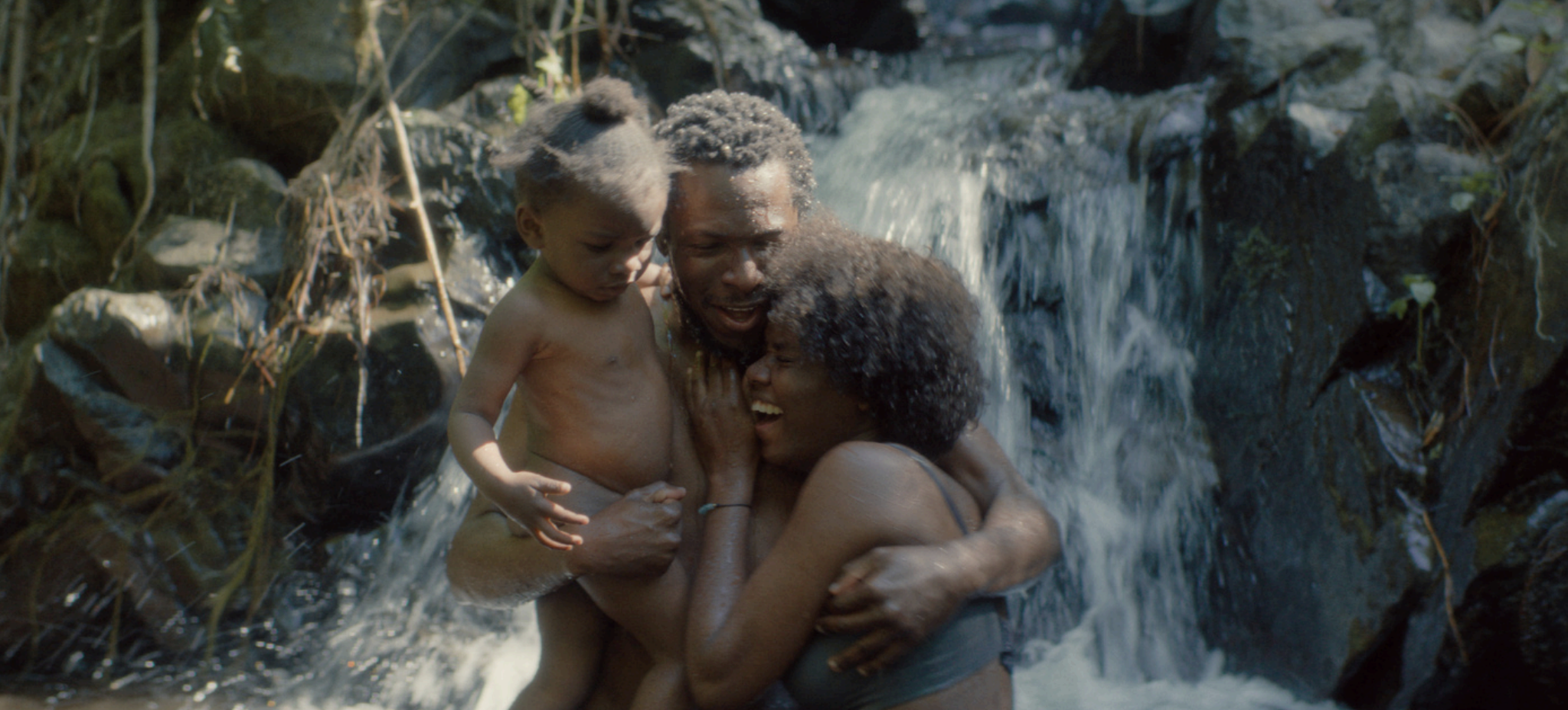
Hope is as rare as it is dangerous for a migrating Haitian family in Mexican director Joaquín del Paso’s second feature THE GARDEN WE DREAMED. Esther (Nehemie Bastien) is a mother of two, a toddler by the name of Aisha and a young asthmatic girl called Flor. On the arduous journey from Haiti, they meet Junior (Faustin Pierre), a man who had lost his family to an earthquake, and who quickly assumes the role as “papa” to the children.
On their passage north, Haitians take highly perilous routes, often making their way first south to Chile, Brazil or Ecuador, before crossing the continent north by land. The movie starts as the new family is dropped off at a remote location in the Mexican forest. Illegal loggers make an outpost for them so the family can maintain the road and keep guard.
At first, this seems like the reprieve they’ve been looking for. Not so much because a hastily-made shack in the jungle is anyone’s notion of a safe haven, but simply because they very much need a break. After all, a forest in Mexico can’t have been what they imagined when they left home looking for a better life.
The forest is also home to millions of north-migrating monarchs, whose journey throughout the film parallels the migrants’. As the family plays among the butterflies, they reminisce about a dangerous river crossing (likely the Darien gap), the kids jump around the tall serene grass, and in the night they receive their daily drops of food and medicine. On one of the drops, Junior thinks he heard the guy cursing at him. “What did he call me?” he asks Esther. She shrugs with a smile as if to say “it probably doesn’t matter”.
One day while the family has a bath in a waterfall, Flor has an asthma attack and to their dismay, her inhaler is nowhere to be found. Junior asks Tono (Carlos Esquivel), the logger who hired him, for a new inhaler, but the evening drop arrives without one. Flor’s situation gets worse, so the next morning, the family decides to walk down to the village in search of help.
Before they get there, they are stopped at a checkpoint by armed locals who are against the illegal logging of the forest. Despite Esther’s desperate efforts to plead with them, the family is turned around without medicine. When they go back to the shack, they find that someone has set it ablaze.
In the evening, Tono comes with a doctor to check on Flor, but announces to Junior that he now must work to pay for the burned down shack, food, and medicine that he had provided for them. The next day, Junior goes to work where his first assignment is to cut down a big tree. Junior finds that he enjoys the work, and is happy to bring back money to the family. Esther, however, is starting to feel uncomfortable with the situation.
The next night, Flor’s situation deteriorates again and Esther asks Junior to come back but he insists on spending the night at work. Esther goes down to the river to get water and sees Tono execute a disgruntled villager.
Things go from bad to worse, but the one constant is that help never arrives. Del Paso, a native of Mexico, resists the urge to create a savior story or a « few bad apples but mostly good ones » narrative. Instead, he chooses a pattern that is much more consistent with our world today: migrating persons are not to be helped. Local populations rarely care.
This reality is not there because the migrant issue has gotten better, rather the contrary. Seeing migrants suffer is now a fact of daily life, shared by both rich and developing countries. Although there are some hopeful elements to the film, you will spend the majority of it in panic over the state of the family. A record high of 1.4 million Haitians are now displaced, due to natural disasters, political instability, and recurring episodes of violence. The few that arrive at their destinations face deportation, violence, and racist attacks, including by the President of the United States, who has repeatedly spread false narratives that they eat pet dogs and cats. Helping migrants has also become a criminal act that leads to prosecution and jail sentences.
As the family’s situation degrades, so does the butterflies’, now many lying dead. Distraught, Flor begins to collect their corpses.
A few men come to the shack and threaten to hurt the family, with one referring to Esther saying they will come back to “take care of her”. Esther grabs the two kids and goes to Junior’s work location to try to get him to leave. Junior refuses again but promises he will come back later that night. Tono lies to him to keep him working, and Junior spends the second night at work.
At home, Flor’s situation deteriorates, as the shack falls apart, leaking from the pouring rain. In the morning, a distressed Esther picks up both kids and starts walking, in search of help. She covers the three of them in a small plastic bag. After failing to find anyone, she drops from exhaustion and Flor falls to the floor, visibly not breathing. Then all of a sudden, Flor wakes up.
Tono, engaging in a common enslavement tactic, repeats to Junior that he has to work for him for a long time to repay his debt and orders armed men to forcibly take him back to work. Soon after, their logging convoy is ambushed, killing most of the loggers. Esther takes the two children and finds Junior who has been shot in the leg. Together they slowly walk in a new direction. At one point, much like Flor, Junior drops to the ground, visibly not breathing. The voice of Flor is heard saying “I see a house”, and the credits roll.
THE GARDEN WE DREAMED is both heartbreaking and powerful, boasting two incredible performances from Bastien and Pierre. For both the family and the audience, the fear never goes away, the cause of fear is the only thing that changes.
You’ll probably read a lot more about the metaphor of the butterflies in other reviews, and I too, was tempted to write this review centered around butterflies. However, the human suffering at the core of the story is so heartbreaking and common that it’s tough to focus on anything else. There are an estimated 14 million unauthorized immigrants in the US alone, every single one living in fear, facing increasingly precarious situations and living at the precipice of the cruel treatment they thought they had left behind. Almost a million and a half migrants travel through Mexico, facing conditions similar to the family in the film. Joaquín del Paso’s film offers a glimpse into this painfully common story.