
Pick #951
Dir. Akira Kurosawa · France, Japan · Japanese
Akira Kurosawa’s adaptation of King Lear is an epic historical drama set in sixteenth-century Japan, abundant with blood, betrayal, and battles for ultimate power.
1985 Movie Action, Drama, History




Our take
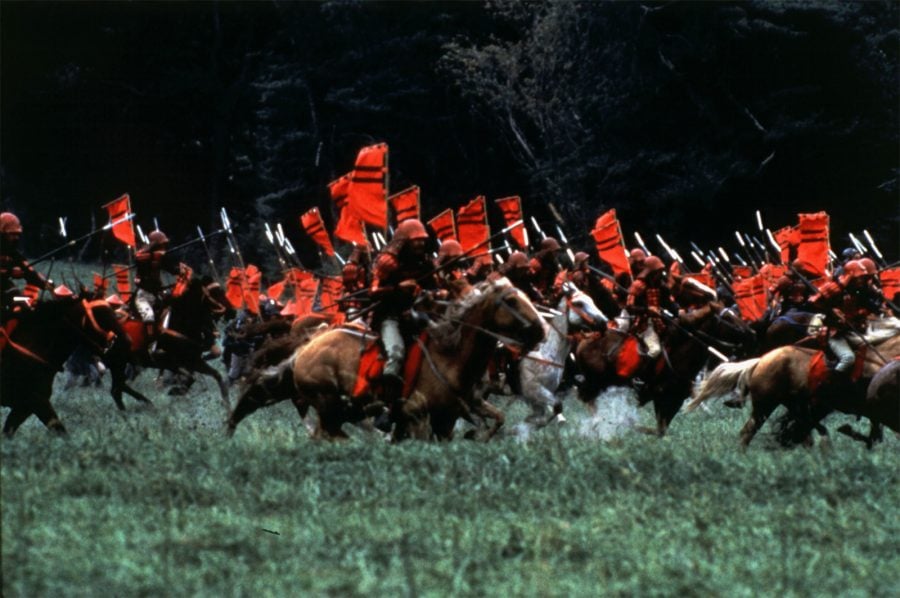
An attempt to articulate just how vast and magnificent the scope of Akira Kurosawa’s 乱 (Ran) is will inevitably fall short. Recognized as a master of epics, including his 七人の侍 (Seven Samurai, 1954), Kurosawa reimagines Shakespeare’s tragic King Lear set in medieval Japan. Each shot is labored and precise, as sublime landscapes overwhelm the screen, dwarfing the armies of men fighting below.
At the center of the ensuing wars is Hidetora Ichimonji, an aging warlord. Ichimonji divides his conquered land between his three sons, Taro, Jiro, Saburo. The Ichimonji clan, however, will not settle for less than everything. Father and sons scheme against one another, leading to violent plots for control over the kingdom. Greed poisons the Ichimonji’s bloodline, pervasive and all-consuming. The tragedy that unfolds is indeed as poignant as any great Shakespeare work.
The road ahead is lined with bodies, blood, jealousy, paranoia—and it’s a long way to the bottom from the throne. Kurosawa, confronting his own mortality and legacy, achieves a titanic masterpiece with Ran. Few films so deeply grasp the tragedy of war at this visceral level. While Ran is not an easy watch, it’s a must-watch for all.
What it won

Oscars
1 win · 3 noms

Golden Globes
1 nom

BAFTA
2 wins · 4 noms

Spirit Awards
1 nom

Nat. Board of Review
2 wins · 1 nom

NYFCC
1 win · 1 nom

LAFCA
2 wins · 1 nom

César Awards
2 noms
The story
Shakespeare's King Lear is reimagined as a singular historical epic set in sixteenth-century Japan where an aging warlord divides his kingdom between his three sons.
Elsewhere

"At age 75, the director has made his most costly epic to date, and it's a dazzlingly successful addition to his distinguished career."
— Variety Staff
Streaming arrival
Who picked it
Taylor Leigh Harper is a writer from Southern California who covers film and writes across fiction, creative nonfiction, and free verse. She is a contributing writer and curator at A Good Movie to Watch, with work also appearing in Westwind, The Bridge, and Haunted Waters Press.