

Movies to Watch From Denmark
To access filters, visit our homepage.
Given the original real-life story behind it, perhaps it shouldn’t be surprising that The Girl with the Needle was so bleak. Serial killing, after all, is bad. But rather than focus on the historical killer, writer-director Magnus von Horn hones the camera to focus on one such mother that would have sought for help from Dagmar Overbye, on the circumstances that would have pushed them there, and the terror that they felt once they realized the truth. With gothic black-and-white shots, impeccable framing, and an excellent performance from Vic Carmen Sonne, The Girl with the Needle is harrowing and heartbreaking, especially with how it still remains relevant to our time.
Written, directed, and scored by Viggo Mortensen, The Dead Don’t Hurt is a visually stunning, emotionally potent, but still impressively restrained period drama that flips the script on typical Westerns. On the surface, it looks like it could be one—there’s even a bad guy clad in black who slings guns outside a saloon—but the film decidedly focuses on Vivienne and her everyday life. Viewers might think nothing is happening, but in fact, everything is happening, such is Mortensen’s framing of the value of these overlooked aspects of life. Immigrants, too, who are usually just extras in Westerns populate this movie and make it their own—as they should. They’re the backbone of America after all, and yet they’re usually relegated to the background in period dramas. The icing on the cake is that the film is breathtakingly beautiful, each frame a transportive picture of 19th-century America.
Apple TV+’s stunning Omnivore is sleek and stylish enough to make it stand out from the usual food and travel shows you might find on TV. There are expertly shot scenes from around the world, exclusive interviews, and maybe best of all, a well-written script that’s just as colorful and delectable as the dishes onscreen. Each episode, which hones in on a specific ingredient like corn or chili, has a tight runtime at just 30 minutes, making it extremely bingeable (though ideally not on an empty stomach). That said, the show might be too polished for viewers who are expecting the gritty and immersive approach of a chef like Anthony Bourdain. Omnivore, for all its explorative language, is suspiciously idyllic at times, all too eager to paint the global food industry as a harmonious process as opposed to an enterprise that is involved in global warming, animal poaching, and deforestation, among others. Every industry has a dark side, and I just wished the show appreciated the nuance in that. Still, it’s an engaging watch with glowing moments.
Horse riding. Gunslinging. Revenge and protection. These are notable elements in a Western, Spaghetti or otherwise. But rarely do these movies contemplate the indigenous tribes that originally lived in these desert towns, right before they were chased away and killed by white colonizers. Writer-director Felipe Gálvez Haberle takes these elements to showcase a new perspective in The Settlers, with mestizo Chilean sharpshooter Segundo forced to inflict atrocities onto his fellow native Chileans by the orders of a wealthy Spanish landowner, a British officer, and an American mercenary. The landscapes captured are sublime, the portraits are vignetted, but what’s most striking is the way Gálvez mixes in cinematic Western film style with real life colonial history, dramatic conflict with historical detail on a rarely discussed genocide.
On the one hand, Godland is a film about nature’s unforgiving beauty. Like the photographs the priest Lucas (Elliott Crosset Hove) takes, these quietly superb scenes speak for themselves. The Earth moves in mysterious and harsh ways, and we are but mere specks, organic matter to be folded in and absorbed, in the grand scheme of things. It would’ve worked with just this message alone, but Godland also treads on political ground. Through Lucas, who is Danish, and his travel guide Ragnar (Ingvar Sigurdsson), who is Icelandic, we sense a palpable tension that electrifies the film with a colonial strain. There are layers to their deep aversion (and dependence) on one another, and director Hlynur Pálmason does well to pair this with imagery that is just complex, profound, and packed with meaning.
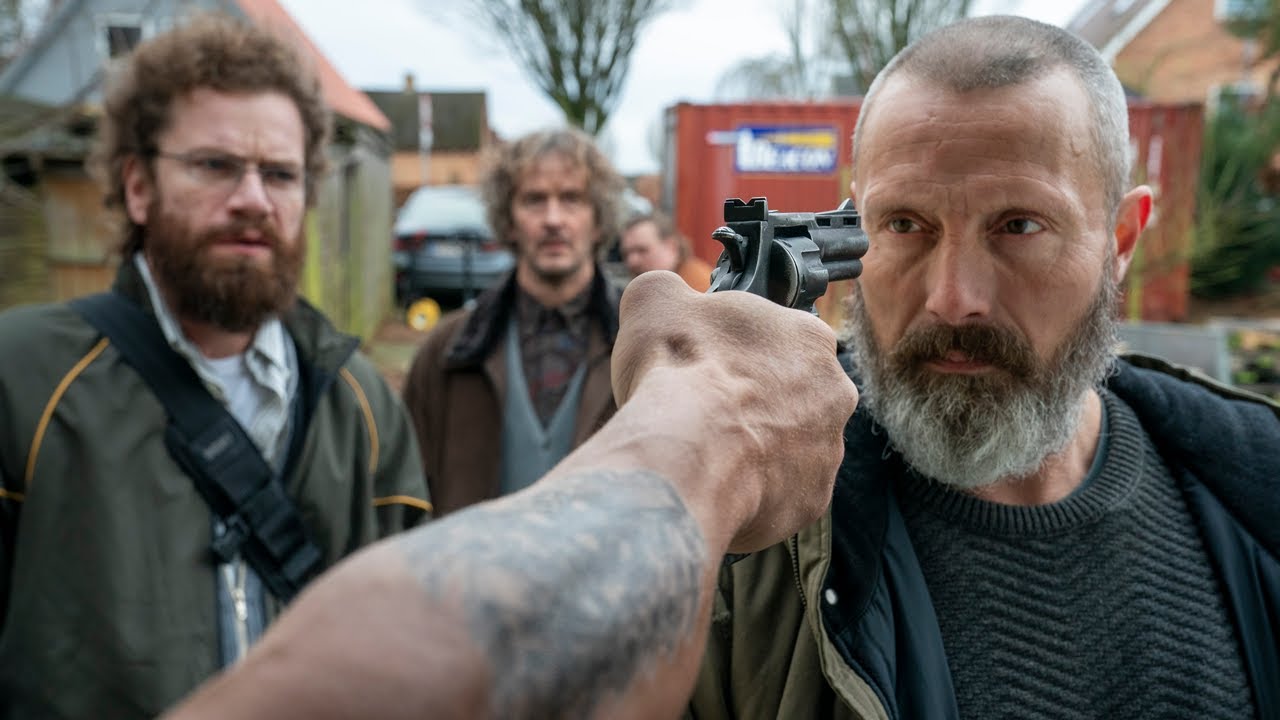
In The Promised Land, director Nikolaj Arcel (A Royal Affair) and Mads Mikkelsen reunite to create another intense, enjoyable drama based on true historical events. Mikkelsen is reliably gripping as Captain Ludwig Kahlen, but it’s his back-and-forths with the diabolical landowner Frederik Schinkel (Simon Bennebjerg) that are the standout scenes here. And though The Promised Land resembles modern Westerns in its macho standoffs and sweeping backdrops, it has a surprising and satisfying feminist bent to it. It’s a historical epic that doubles as a revenge thriller and succeeds in both cases.
It’s slower and talkier than you’d expect from a semi-erotic film, but Ehnegard lives up to its title well enough to satisfy. It’s titillating, but in a cheeky rather than provocative way. The dialogues are lengthy, but they’re alternately witty and poetic, so despite the pace they never actually bore. Ehnegard’s real delight, however, is its beauty. Set in the old kingdom of Babenhausen, Ehnegard looks like a fairy tale come to life. The towering castles, the sprawling meadows, the twinkling forest lakes, and of course, the smartly costumed people who populate the scenery—all these and more ensure that each frame has a picturesque glow to it. And with Sidse Babett Knudsen (Borgen, Westworld) taking charge of an appealing cast, Ehnegard proves to be a charming watch.
There are plenty of versions of the Cinderella story, but none as brutal and nauseating as The Ugly Stepsister. For one, it’s not a lovely fairytale that rewards the perseverance of good people through a royal romance. Instead, this European folklore inspired body horror takes the perspective of its titular character, a stepsister who is forced to undergo invasive procedures for the sake of her family. It’s absolutely gruesome. Every single terrible thing Elvira goes through eerily recalls today’s plastic surgery and diet culture except without modern-day tools and anaesthesia. Those new to horror, or those who would be triggered by these topics, would find the film hard to watch. Still, The Ugly Stepsister deeply understands the dark side of this oft-told fairytale, especially at how marriage used to be the only means to upward mobility for women.
As a crime thriller, Holy Spider is taut and terrifying, a modern noir that manages to unnerve despite the familiar moves it employs. The cat and mouse chase between serial killer and investigative reporter, for instance, is a classic tale, but that doesn’t make Holy Spider any less gripping. The film benefits from artful camerawork, considered acting (as the daring journalist Rahimi, Zar Amir Ebrahimi nabbed the Best Actress award at Cannes), and most of all a nuanced take on the situation in Iran.
Despite having a clear stance against violence and corruption, nothing in Holy Spider is black and white. Contradictions abound, and even when presented with brief moments of justice, we’re left scratching our heads looking for more. Such is the case when the system, and not just an individual, is the true pest.
Surprisingly dramatic for a documentary but without exoticizing its central characters for a privileged audience, The Territory is that rare film that rightfully portrays indigenous peoples as living firmly in the present. In their continuing struggle to protect their land and culture, the Uru-eu-wau-wau people of the Amazon may be vulnerable, but they aren’t helpless. They’re organized, have access to technology, and know exactly how they want to represent themselves—armed with bows and arrows and defending what’s theirs in beautiful, thrilling footage. In this way, even as The Territory ultimately touches on issues that have affected all of Brazil, namely the destructive effects of Jair Bolsonaro’s presidency, it still feels like a documentary co-authored by these indigenous people themselves.
One woman’s main character syndrome reaches shocking lows in this vicious Norwegian satire of social-media-era narcissists. Signe (Kristine Kujath Thorp) and her artist boyfriend Thomas (Eirik Sæther) are a deeply toxic couple who torture everyone around them with their constant, petty one-upmanship. When he lands a flashy magazine spread, though, Signe’s usual tactics for slyly redirecting attention her way don’t cut it anymore, and so this compulsive liar takes drastic action and begins overdosing on pills banned for their serious dermatological side effects.
Signe’s Munchausen-esque actions have their desired effect: the physically dramatic results instantly make her the center of attention — but not indefinitely. As she craves increasingly bigger spotlights, the film toggles between reality and scenes from her imagination, including a morbid sexual fantasy in which her funeral proves so popular the priest becomes a bouncer, turning away sobbing mourners whom Signe noticed hadn’t visited her in hospital. The rampant narcissism on display here is at turns hilarious and excruciating: Sick of Myself’s sharp social observation skills make it feel, in places, like a movie by cringe-master Ruben Östlund. That stomach-turning effect carries through to the ending, which darkly suggests that, for someone like Signe, even narcissism itself is a condition that can be weaponized for attention.
When he’s accepted into the prestigious Islamic university Al-Azhar, fisherman’s son Adam (Tawfeek Barhom) gets an eye-opening education — but not the kind he expected. A place associated with notions of purity is imagined as a hotbed of hypocrisy and corruption here, as naive young Adam finds himself unwittingly embroiled in a state plot to seize control of Al-Azhar (because, as one government official puts it, “We can’t accept having two pharaohs in the land”). Cairo Conspiracy’s intricate plot confronts monsters in government and strips away religious leaders’ veneer of divinity as a reminder that they’re merely fallible men. What’s more, the film grapples with the knotty mess of politics raging inside the institution’s walls in such a way that even its palatial courtyard feels claustrophobic. Rife with paranoia and subterfuge, Cairo Conspiracy feels utterly unique thanks to this skillful transposing of the shadowy machinations of courtly intrigue dramas and ’70s paranoid thrillers into a very contemporary Egyptian setting.
There are many ways through which a friendship can form, but sometimes, it’s due to compassion for someone who needs help. Despite the somewhat fantastical clairvoyant premise, Beautiful Beings is mostly about this simple friendship formed with a bullied kid, which turns out not to be so simple at all. From a bummed cigarette, the friendship grows into a protective support system, filling up parental neglect with teaching each other how to live, but while some of these moments are totally wholesome, other moments lean into mischief, and sometimes violent danger. It may be a fairly familiar coming-of-age premise about male friendship, but Berdreymi executes it well, has a compelling cast, and isn’t afraid to go dark when necessary.
The Innocents is a Norweigan thriller that follows four kids who discover they have supernatural powers over the summer. They play around and experiment in the woods nearby, but what begins as harmless fun quickly develops into something much more disturbing and sinister.
This unnerving film, a blend of fantasy and horror, doesn’t waste time explaining the origins of its mysticism. Instead, it goes straight into action—bending, twisting, and splitting open anything and anyone that gets in its way. This kind of rawness is shocking given the age range of the characters, but it also works to subvert what we’ve come to expect from kids, youth, and goodness. The Innocents isn’t for the faint of heart, but if you can manage some bloody and unhindged scenes, then it’s sure worth checking out. Directed by Eskil Vogt, co-writer of critically-acclaimed films like Thelma and The Worst Person in the World.
It would be understandable if it only occurs to you midway through that Little Girl isn’t actually a narrative feature but a gorgeously made documentary. Director Sébastien Lifshitz approaches his main character of Sasha not just with respect and empathy for her identity, but with a dedication to bring out the euphoria of feeling comfortable in one’s skin. As a result, Lifshitz seems to intentionally avoid any and all scenes where Sasha may face discrimination (especially at school), but even if this choice occasionally make the material feel thin, getting to see Sasha gradually learning to express herself more—or even just just seeing her enjoy a quiet moment on her own—is more precious than anything.
The real life situation behind this harrowing drama is quite extraordinary, so adapting Daniel Rye’s captivity straightforwardly would already intrigue viewers into watching it. However, Held for Ransom does more than depict his torture. Alternating between his captivity and the fundraising efforts back home, the film examines the way they have all responded to the unimaginable, the horrible experience that they have gone through because of extremism. The imprisonment sets the stakes, but the humanity held onto by the hostages, the fierce love of Daniel’s family that would bring him home, and the human cost of non-negotiation pushes this story into somewhere new.
The Apprentice is as much about Roy Cohn as it is about the titular mentee, a very green Donald Trump. It’s Cohn who teaches Trump the dirty tricks and the power moves, and it’s he who instills in him his everlasting entitlement. It’s also Cohn who arguably steals the show. As expected, Strong disappears into his character and is at once terrifying and pathetic, but always arresting. Stan is less effective as Trump, but his more subtle turn as the real estate mogul still works, especially when set against Cohn’s more hardened and vulnerable persona. The film is powered by these two; without them, it moves like any old tale about greed, power, and betrayal. It doesn’t shy away from Trump’s known grotesqueries, but it also could’ve benefited from leaning into them more, a la Wolf of Wall Street. As it stands, The Apprentice is familiar fare elevated by the engaging performances of two of Hollywood’s best-working character actors.
This crazy adventure thriller was Colombia’s nomination for the 2020 Oscars. “Monos” translates to monkeys, the nom de guerre of a group of teenagers holding an American hostage in an isolated bunker. Other than the occasional visit from their supervisor, they’re left to their devices, forming relationships, smoking weed, drinking, and eating psychedelic mushrooms. One day, on top of the hostage, they’re also trusted with a milk cow, named Shakira. A party goes wrong and one of the Monos accidentally kills Shakira, triggering a series of events that sends them deep into the jungle, and deep into despair.
Monos is not an action movie, it’s more of a character study. It was loosely based on The Lord of the Flies.
There is no shortage of resources—be it books, films, articles, or interviews—about the atrocities Ferdinand Marcos unleashed on the Philippines. And yet, in the years since his exile and eventual death, his family has returned to power in the country, winning the hearts and (manipulated) minds of the masses.
In The Kingmaker, director Lauren Greenfield (who earlier directed the equally revealing The Queen of Versailles) exposes how this came to be, with a focus on the titular kingmaker herself, Imelda Marcos. It’s chilling how much of Imelda’s stated goals in this documentary, which spans five years, have come true. History repeats itself, and Greenfield skillfully and delicately captures the delusion, irony, and blatant corruption of a family dead set on owning a country, as if it were another luxury to purchase (or in the case of the Marcoses, pocket).
On paper, Crossing’s premise reads like a movie about two different people forging an unlikely but sweet bond. Lia is a no-nonsense grandma, after all, and Achi looks like he lives day-to-day, not really caring what the future brings. And it’s true, at first their stark differences provide amusing moments, but the pair quickly subvert expectations. Lia is almost unrelentingly distant (“Let’s be clear,” she warns Achi, “I’m not here to take care of you.”) while Achi proves to be surprisingly sweet. Then there’s Evrim (Deniz Dumanli), a local trans lawyer advocating for the marginalized. Through her and her friends, Lia grows to understand her missing trans niece, the reason she came to Turkey in the first place. There’s a meandering vibe to Crossing that fits into these three characters yearning for connections. But though it can get lost in those paths, the movie feels coherent and kind, like a comfort drama if there ever was one. All the while, Istanbul—both its fringes and its colorful center—serves as a ruggedly beautiful, kaleidoscopic backdrop.
Organized crime and drug dealing has been a topic of many a film, sometimes even glamorizing the whole endeavor, but rarely do these depictions acknowledge the weight it can do to a culture, particularly indigenous cultures. Birds of Passage is a film about drug dealers, but it’s a much more distinct take, tackling Colombia’s reputation for the drug trade through the lens of an indigenous group that hasn’t been totally colonized, that still keeps its language, rituals, and legends, but is still pushed to the brink due to far more lucrative reasons. It does take fairly familiar plot points, but Birds of Passages transforms the narco crime drama with a different direction.
This Danish film which was the country’s submission to the Oscars is about a delicate subject. A lawyer who specializes in defending children, and who is used to developing closeness with her clients including meeting with them in her home, starts having an affair with her teenage step-son.
There is inherent tension to this obviously very explicit plotline: how would a serious, non-erotic (or not-only-erotic) movie like this one portray such attraction. And of course, afterwards, what are the implications?
This is a gorgeous Danish period drama that’s based on a famous story and book in Denmark called Lykke-Per (or Lucky Per) by Nobel Prize-winning author Henrik Pontoppidan.
Per, the son of an overbearing catholic priest, leaves his family house in the country side to seek a new life in Copenhagen. His passion about engineering was at the time contrary with the Christian faith, but manages to introduce him to the capital’s elite, and a chance at social ascension.
Lykke-Per and A Fortunate Man are about nature versus nurture. Per’s passion about engineering and renewable energy (back in the 1920s) is set against his need to emancipate and the pride that was instilled in him by his upbringing.
This Swedish movie is the story of Astrid Lindgren, one of the most translated children book writers of all time. Her work of over 100 books includes Pippi Longstocking and The Brothers Lionheart.
Away from the quiet existence of the characters she would later create, Astrid had a turbulent life. Her troubles start when she falls for the editor of the paper she worked at when she was young, a man 30 years her senior. This results in an unwanted pregnancy and Astrid is pushed to immigrate.
While best known for his provocative, existential dramas, Lars von Trier also made a provocative mini-series with surprising supernatural horror. Set at Denmark’s leading public hospital, The Kingdom takes familiar medical drama conflicts in handheld camera and sepia tone, but infused with an unsettling understanding of how the finest minds can fail, and how small science can feel in the face of the unexplained. That being said, the horror is much more wacky than spine-tingling or terrifying, but it’s played off through von Trier’s signature absurdism, taking a more humorous and sardonic approach. Riget may be an unexpected entry for those who have heard of von Trier, but it’s a must-watch for the auteur’s fans, showing a different side to the notorious director.
This coming-of-age story starts in the present time, where Elle Marja, now a grandmother, reluctantly goes to her sister’s funeral held by her old indigenous Sámi community in Northern Sweden. Understanding her reluctance requires going back to when Elle Marja was 14 and was preparing to go to boarding school with her little sister. These schools were racist establishments meant to integrate the Sámi children into Swedish culture and language, while at the same time limiting their prospects of seeking further education. Elle Marja and her sister chose to respond to this discrimination in two completely different ways that this movie explores without judgment. The central performance of the young girl is incredible.
This thriller is about a modern-day Catholic “assessor” who investigates supernatural cases to see if an exorcism is needed. Don’t believe it? Neither does his partner, a prosecution psychologist.
The two join forces because, according to the assessor, “possession looks a lot like insanity”, and she can help him distinguish between the two.
The heavy religious connotations might bother some they’re nothing but a starting point (every supernatural TV show requires a supernatural premise). If you liked the X Files, for example, you will love this.
Set in one of Morocco’s oldest medinas, Blue Caftan is a tender portrayal of pure love and the different forms it takes. It follows traditional tailor Halim (Saleh Bakri) and his wife Mina (Lubna Azabal) who, despite their imperfect marriage, prove their affection in small but moving ways. He peels tangerines for her and washes her hair, she preps his meals and defends his craft from demanding customers. When a third person, Youssef (Ayoub Missioui), enters the picture, even more manifestations of passion (and the lack and longing and excess of it) emerge.
It’s a dramatic film, but never overly so. Like the silky fabric Halim handles with expert care, it’s rich but soft, detailed but delicate. In the face of poverty, sickness, and discrimination, the film mines moments of joy, friendship, and pleasure, subverting the expectation that tragic circumstances must mean tragic outcomes.
Blue Caftan, even in its saddest moments—and there are plenty—is a film full of love, made even more memorable by the deft performances and palpable chemistry of its three leads.
Set in the small town of Åmål, western Sweden, the debut feature by Lukas Moodysson (We Are the Best), is itself a metonymy for the bigger questions of life. It’s playful and dead serious at the same time, in the way it portrays teenager Agnes, who, after two years of living in Åmål, still hasn’t made any friends that would attend her birthday party. Instead, she spends her time typing away on her computer, poetic diaries and love confessions to a girl from school named Elin. She’s the popular one and therefore, out of reach. The amount of tension and escalating ambivalence the film conjures with just a simple narrative decision—a bet, a kiss, an apology—is palpable throughout the 86 minutes of its runtime. A perfect capsule of lesbian desire and first love, Show Me Love is a gem of a movie; one that would make you think Close was a tad overrated. Oh, and don’t forget to add the titular song by Swedish pop star Robyn to your Spotify favorites.
In 1994, Danish auteur Lars von Trier came up with a TV series called The Kingdom, an absurd supernatural comedy that takes place in a rundown hospital in Copenhagen. The show was well-received enough to warrant a second season, but just as von Trier was polishing up the third and final installment, the deaths of more than one lead actor pressed pause on the project, till now.
More than 10 years in the making, The Kingdom part III, also called Exodus, is still very much centered on the weird patients and staff members that populate the Riget hospital, as well as the possible evil buried beneath it. The comedy/horror has a robot dishwasher and a giant head. Danes and Swedes are perennially at war with each other. Willem Dafoe and Alexander Skarsgard make odd cameos.
I’m not sure it’s possible to write a coherent synopsis without sounding like I’ve fallen off the rails, but know that it is a unique headscratcher of a show, more interesting as an experience than anything else. Von Trier was also openly inspired by Twin Peaks, in making it, so David Lynch fans in particular will truly enjoy diving into this world.
Somewhere near the border between Russia and Ukraine lies a shelter for kids coming from unstable homes. Their parents, either alcoholics or abusers, have nine months to prove that they’re fit to look after their children; otherwise, the kids are sent straight to the orphanage, with no chance of a goodbye. A House Made of Splinters is a documentary that quietly and closely follows the shelter’s occupants amid growing joys and pains, not to mention the ever-present danger of war.
Perhaps one of the most striking things about A House Made of Splinters is how attuned it is to the kids. It serves as a reminder of their immense sensitivity and observational skills (more than once, you’ll hear a child assess their home situation in the calmest of manners), as well as their clever ingenuity (there’s a lot of playing going on despite everything, which is heartwarming to watch.
You might not have heard of it, but this show was huge in Denmark. I mean, one million people watching in a 5-million-people country huge. Far from being the tasteful Nordic Noir international audiences are used to, Rita revolves around a mid-40s, single mum of three older kids, leather jacket-clad private high school teacher with a big mouth and a heart to go with it. Mille Dinesen plays the titular female lead, who smokes in the school bathrooms and, well, bangs the school principal. But in addition to the rule-bending rebel facing off overprotective parents, know-it-all students, and her growing kids, Rita also deals with serious topics like balancing work and family, being a role model, and abortion, albeit in a hilarious and, well, delightfully Danish way.
If you like: weird movies and / or Scandinavian mythology, this movie is for you. It’s about unusual looking border agent with super-human abilities (such as smelling fear and shame) who meets someone like her for the first time There is a big revelation in Border that I can’t share but while this movie was directed by an Iranian (Ali Abbasi), it’s deeply rooted in Swedish folklore. Themes of identity, gender, and otherness intersect through a thrilling script and beautifully-shot nature scenes.
Children like to play, but sometimes the line between regular roughhousing and outright bullying gets blurry, especially for people watching from the outside. What happens in this Swedish drama is clearly bullying, though. However, the audience could only recognize it as bullying because of the point of view, since the camera is present from start to finish, unlike the silent adults who witness these incidents halfway, or the well-meaning bystanders that interfere without any context. It’s an interesting depiction of bullying based on multiple court cases, but writer-director Ruben Östlund and producer Erik Hemmendorff adds fuel to the fire with the character choices, unabashedly exploring the different ways leadership has failed to address this issue.
Joachim and Ceilie are engaged to be married when a car crash leaves the former paralyzed. While Joachim recovers in the hospital, Ceilie becomes entangled with his doctor—who also happens to be the husband of the woman who caused Joachim’s accident. What transpires after is not unlike a car crash itself: gut-wrenching to watch, impossible to look away from.
Although the film’s premise toes the line of melodrama, Susanne Bier handles the characters with extraordinary care. Elsker dig for evigt (Open Hearts) boasts incredible performances from its core cast of four, with Mads Mikkelsen and Paprika Steen particularly shining. This is not an easy nor feel-good movie to sit through, but its unflinching gaze at complicated characters in a tragic situation makes for a rewarding journey.
A Danish cargo ship is hijacked by Somali pirates in the Indian Ocean. The pirates demand millions of dollars in ransom and from there on, a psychological drama between the pirates and the ship owner develops, as they negotiate the price for the ship and its crew. A really great thing about this film is the fact that it doesn’t get tangled up in the weepy feelings of the families back home – but instead focuses on the shrinking hope of the ship’s crew and the psychological consequences of the brutal negotiation, that drives the ship owner to the edge of madness. Inspired by a true story. Brilliantly acted.
We’ve seen anthology films with three, four, sometimes even five parts, but Songs from the Second Floor comprises forty six separate vignettes, quickly shifting in and out without any connecting thread inbetween, except for the dull gray color palette. Yet, even as the film abruptly transitions between vignettes, from tanning beds, construction sites, cars, trains, or buildings, writer-director Roy Andersson crafts meticulously framed breakdowns of modern day living, some of which works based on individual experiences, but all coming together as several miniature portraits of how absurd and depressing our lives have become. Songs from the Second Floor is a bold way to return after a twenty five year hiatus.
Sisters Martine and Filippa, daughters of a founder of a religious sect, live a simple and quiet life in a remote coastal village in Denmark. Throughout the course of their lives, they reject possible romances and fame as part of their commitment to deny earthly attachments. This is upended by the sudden arrival of a French immigrant named Babette, who served as their house help to escape the civil war raging in her country.
Babette’s Feast is an inquiry into simplicity and kindness, and whether these would be sufficient to achieve a life of contentment. The religious undertones perfectly fit with the film’s parable-like structure, where bodily and spiritual appetites are satisfied through a sumptuous feast of love, forgiveness, and gratitude.
There isn’t a single moment of unnecessarily exaggerated emotion or comedy in this French-Danish animated film, which may keep its world very small compared to its peers, but it portrays everything with arguably more depth and beauty. Long Way North moves with a stately pace, giving it more dramatic heft and allowing us to take in all of the film’s painterly surfaces and soft silhouettes. But it’s not just the art style that sets the film apart; it also avoids what we expect from a traditional adventure, keeping the most important character beats private and internal. This may make the movie feel a little more distant than it should be, but the feeling that it leaves you with is undeniable—a sense that everything is connected, and those who are lost will always find a way home.
For the longest time, American media coverage was skewed to justify the presence of US forces in Arab states. Control Room unveils that bias by following Al Jazeera at the start of the Iraq War in 2003. One of the biggest Arab media outlets at the time, Al Jazeera dared to cover both sides of the war, but by doing so put a target on its back. It was vilified by both the US government, which called it an Osama mouthpiece and the Arab world, which called it a Bush ally.
Control Room shows the difficulty (if not sheer impossibility) of achieving journalistic balance, objectivity, and integrity. Through interviews with Al Jazeera reporters and US military officers, we witness how lines are blurred, loyalties are tested, and purpose is shifted in a state of war. A seminal work on media bias and press control, Control Room is vital and enlightening, a must-watch to understand the inner workings of the fourth estate.
World War II changed the fate of many countries, but most prominently that of the European continent and the United States of America. Though late to the battlefield, America was one of the victors that occupied Germany after the war, and it’s this tension and setting that is at the center of Lars von Trier’s lone war drama Europa. Alternatively known as Zentropa in some territories, the film is inspired by Hollywood noir, from the black and white film to the femme fatale, but the film takes more experimental routes, starting off with lulling the viewers in a hypnotic trance, and later playing on with rear-projection and multiple layers for surreal effect. It takes noirish cynicism on a ride, exaggerating history but nonetheless reflects the way this memory is formed in the cinema of its respective countries. Europa is a fascinating breakdown of an idealist that hasn’t gone through the same terrors, one that still lingers in today’s consciousness.
A Swedish film about a world-famous conductor who suddenly interrupts his career to return alone to his childhood village in Norrland. It doesn’t take long before he is asked to come and listen to the fragment of a church choir, which practices every Thursday in the parish hall. “Just come along and give a little bit of good advice”. He can’t say no, and from that moment, nothing in the village is the same again. The choir develops and grows. He makes both friends and enemies. And he finds love. It’s a wonderful movie about faith, values, and the exploration of one’s spirit.
When a group of percussionists illegally carry out a city-wide performance act, it’s up to policeman Amadeus Warnebring to stop them. The musical fugitives perform on stolen objects and disrupt public spaces, but Warnebring has his own reasons to pursue them so determinedly: he’s tone-deaf for one and born into a family of snobby musical geniuses for another, making this case all the more meaningful and consequential to him.
Sound of Noise is more than reminiscent of Stomp, what with its playful symphonies subsisting on random borrowed objects, but it is livened up with the suspense of a caper, the dry wit of a Swedish comedy, and the abundant charms of a light romance.
A War (Krigen) is a Danish war drama that focuses on Commander Claus Pedersen (Pilou Asbæk) as he leads a company of soldiers in modern day Afghanistan, while his wife at home in Denmark struggles to care for their three children. During a mission to rescue a family from Taliban threat, Claus’ unit is overcome by enemy fire, forcing him to make a dramatic decision that has a complicated effect upon himself, his fellow soldiers, and his family back home. A War is a tense yet thoroughly involving drama that offers a profound example of moral ambiguity and the repercussions of warfare. The acting and direction are utterly superb across the board—another enthralling and superbly humanistic affair from Danish filmmaker Tobias Lindholm (A Hijacking).
A seemingly well-adjusted Scandinavian Family vacationing in the French Alps experiences a frightening avalanche scare near the beginning of Force Majeure, thereby unleashing a cacophony of mistrust and anxiety as their dynamic is shaken to the core. This pitch black comedy from Sweden charts the steady disintegration of the family unit and the father’s psyche in particular, as his reaction to impending death leaves his family deeply questioning his masculinity and prioritization of their well-being. The stages of blame and negotiation play out with painful honesty, holding back very little in a manner that leaves the viewer supremely uncomfortable, as if eavesdropping on a neighbor’s personal affairs. The effect is unsettling yet stunningly honest and often laugh-quietly-on-the-inside worthy in its depiction of human vulnerability. Unlike many narrative films, the “climax” comes at the beginning of Force Majeure, with the remainder of the film acting as an extended denouement in the form of a measured, Kubrickian character study.
A wonderful homage to the woman, actress, and mother based largely on her own archives and interviews with her four children. Bergman was an avid photographer, filmographer and letter writer. What emerges is a loving portrait of an adventurous, driven, complex, and loving woman. Not to be missed.
Lauren Greenfield’s film follows the Siegel family’s decline from opulent abundance to gaudy ruin. Mega wealth, delusions of grandeur, and grotesquely opulent taste—the Siegel family were the perfect subjects for the film, which sets out to document their most lavish expense: their Versailles home, a mansion sprawling more than 85,000 square feet and modeled after the Palace of Versailles.
The Siegels, no doubt, are entirely out of touch with reality. David Siegel, the owner of one of the world’s largest timeshare developers, married Jackie, a former Mrs. Florida who is 30 years younger. The Versailles home is to be Jackie’s castle, an enormous home for her eight kids and numerous pets.
But the 2008 recession does not spare the Siegels, and their company is devastated. After layoffs and desperate attempts to recover financially, the family struggles to pay back the banks. Construction halts. The Versailles home remains vacant and unfinished.
While the film does not sympathize with the Siegels, Greenfield creates a space where pity is possible as well as criticism. And from there comes the universal: desperation, longing, hope for better, if not also more, more, more.
Much like the 1976 horror classic Carrie, Thelma centers on a young telekinetic woman whose religious upbringing and sexual repression give way to unpredictable moments of fury and rage. When she meets the cool, charismatic Anja, she falls in love immediately, but the wave of emotions that overwhelm her threaten to destabilize not just their budding romance, but other relationships and lives as well.
Thelma recalls Carrie in other ways too, most notably in the way it uses supernatural elements to allude to female fury and lust, but it also stands on its own as a singular piece of work; the mesmerizing transitions, the slow-burn pace, and the undercurrent of melancholia are all known trademarks of director Joachim Trier. This layering of old and new makes Thelma an intriguing watch, at once recognizable and wholly original.
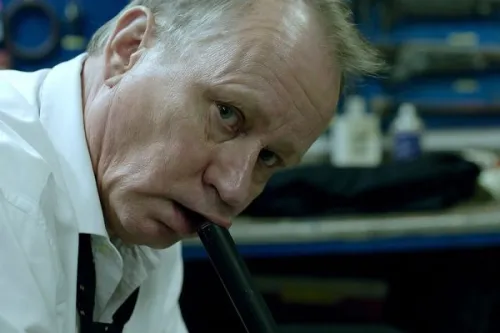
This movie is pretty much in every regard a Norwegian Kill Bill. It’s a dark gory comedy where, naturally, the substitute for Uma Thurman doing damage is an emotionless Stellan Skarsgård.
After his son is killed by a drug gang, Skarsgård’s character, fresh off a win of a “citizen of the year” award, embarks on a ruthless journey to track and kill the murderers. This takes place in one of the most remote areas in Norway, where the main character works as a snowplow driver. You guessed it, some people will get snowplowed.
Seems familiar? That’s because this year it was turned into a horribly sub-par American movie called Cold Pursuit, with, ugh, Liam Neeson.
Taking place entirely on beachside farmlands in Denmark, Land of Mine takes a particularly intimate—and visually distinct—approach to war. The fighting may be over, but the film remains a tense and emotionally distressing, with all the pain and violence being carried over onto these German boys being forced to clear the beaches of live explosives with their bare hands. The relationship between these young men and their vengeful Danish commanding officer may progress a little quickly for some, but their volatile bond only emphasizes that rage isn’t meant to be felt forever, and that war is a destructive cycle that eventually needs to come to an end.
We Are the Best! is one movie that may be overlooked largely by viewers, though it perfectly captures counterculture, and relates to the misfit young and old. The movie is an adaptation of Moodysson’s wife Coco’s graphic novel “Never Goodnight”. Set in Stockholm, Sweden in 1982, Klara (Mira Grosin) and her best friend Bobo (Mira Barkhammar) are junior high teenage girls who believe in their heart that punk rock is alive and well. With both of their home lives not so pleasant, the girls spend their time at the local youth center while taking up the time slot in the band room to get revenge on the local metal band. That’s when they find themselves starting a punk band without even knowing how to play an instrument. We Are the Best! is a fun and deeply sincere exploration of adventure, friendship, love, and betrayal in adolescence.


x12
x2